Introduction
The Ingredients of Great Photographs
Great photographs share certain qualities. Good composition is an important part of what makes an image work, but it is only one part.
There are many other qualities that can contribute to a successful photograph. Throughout this site, I refer to these qualities simply as ingredients.
By becoming more aware of these ingredients, photographers can learn to recognize them while making photographs and while editing their work. The examples on this site offer an opportunity to practise spotting these ingredients in photographs — and, in doing so, to better understand what makes an image work.
Overview of the Ingredients
- 1.
Simplicity
- 2.
Thirds Grid
Subject matter is arranged along the lines of the thirds grid or at their intersections.
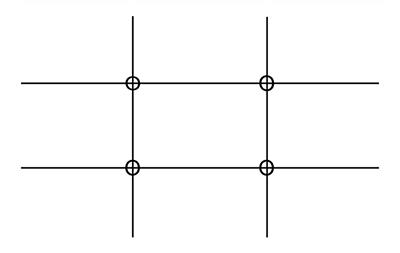
The thirds grid — lines and their four intersections. - 3.
Balance
Dominant elements are arranged in a balanced way within the picture space.
- 4.
Tonal Balance
Elements of similar brightness are balanced within the image.
- 5.
Horizontal Lines
- 6.
Vertical Lines
- 7.
Diagonal Lines
- 8.
Leading Lines
- 9.
Shapes
One or more shapes guide the eye around the image.
- 10.
Patterns
Patterns dominate the composition, though they need not be perfect.
- 11.
Symmetry
- 12.
3D Illusion
A sense of depth or perspective.
- 13.
The Unusual
An unusual subject or an unusual visual treatment of a subject.
- 14.
Interesting Lighting
Often involving selective lighting.
- 15.
Visual Impact
The “wow” factor.
- 16.
Emotional Impact
A strong emotional response to an image.
- 17.
Nature Story
Very common in nature and landscape photography. Nature includes not only living subjects, but anything clearly part of our natural universe.
- 18.
Colour Echo
The colour of a subject is repeated elsewhere in the image, such as in the background.
- 19.
Complementary Colours
Colours opposite one another on the colour wheel, such as red and green, purple and yellow, or orange and blue.
- 20.
Use of Negative Space
The creative use of empty space around or between subjects.
- 21.
The Mysterious
- 22.
Tension
Created, for example, by a fierce subject, crossing diagonals, or an ambiguous composition.
At first, recognizing ingredients may be a challenge. But with some practice you will get better. And they will become a precious part of your eye for beauty.